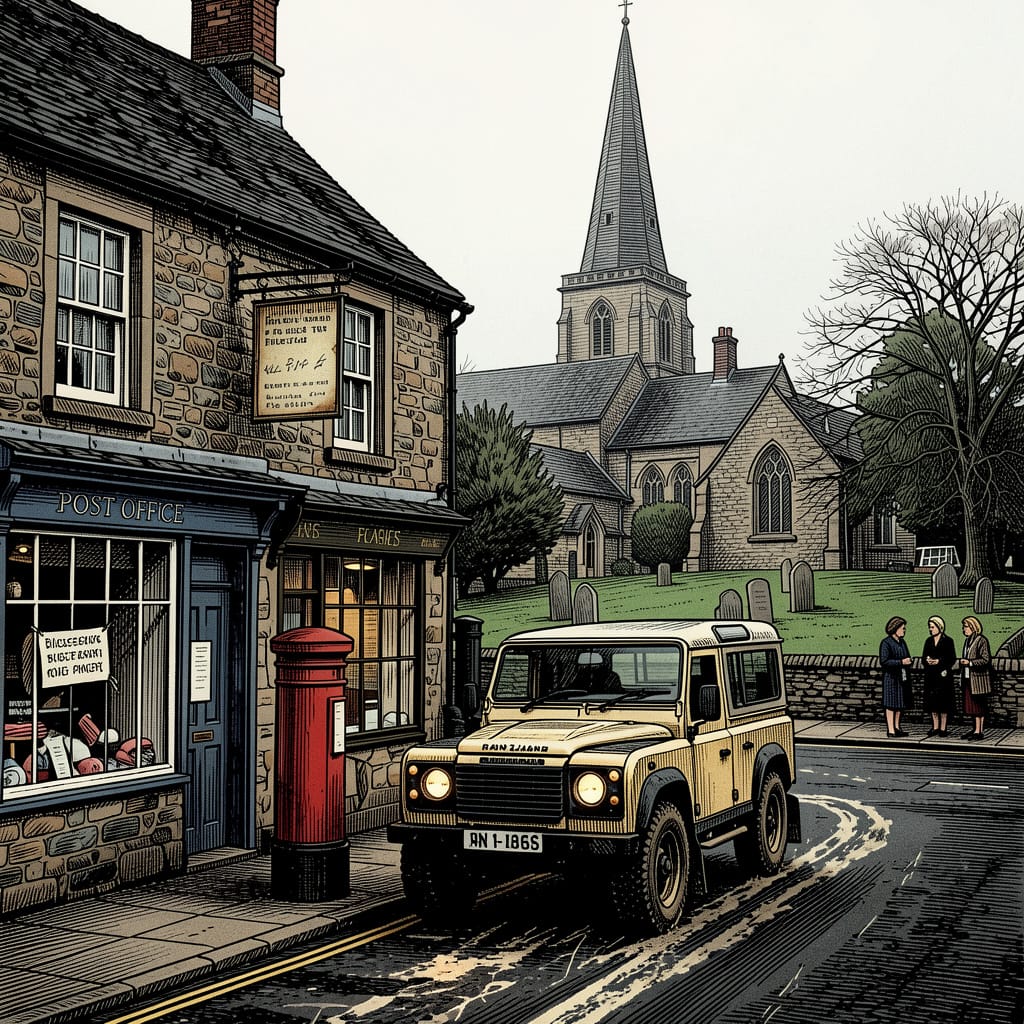
The Post Office and Village Green

The High Street and green, Hope's End

Location Profile
Type Civic landmarks (combined entry)
Village Hope's End, Peak District
Nearby Features Village shop, the butcher's, St Barnabas's Church, the churchyard
Status Active
First Appearance Cambion, Chapter Ten

The Post Office & Village Green

"A community that functions normally on its surface and has learned not to look too hard at what moves beneath it."


Overview

The Post Office and Village Green sit at the civic heart of Hope's End — twinned landmarks around which the ordinary life of the village continues to happen, even as the rest of the saga unfolds in its margins. The post office fronts the High Street, flanked by the village shop and the butcher's. The green opens out behind, with St Barnabas's Church rising beyond it and its churchyard running against the lane.

They are treated throughout Cambion as a unified civic space: the place where the village is most visibly itself, and therefore the place against which its quiet strangenesses register most sharply.


The Post Office

The Hope's End Post Office is a small High Street premises of the kind that still functions as a quasi-official village hall: a place where parcels are collected, pensions drawn, complaints overheard, and the morning's gossip transacted alongside the official correspondence. Its manager is identified only through passing reference; he is one of the people Phillip Lawson is observed speaking to.

Beyond its civic function, the post office also plays an unacknowledged role in the saga's surveillance architecture. A handwritten complaint filed by the post office regarding "strange electrical interference" whenever Robert Knight stands near the scales is intercepted before it reaches anyone with authority to act on it — one of the small documentary traces of Robert's presence that the surveillance apparatus sweeps up and files away.


The Village Green & Churchyard

The green opens out just off the High Street, bordered by the low boundary of the churchyard and overlooked by the spire of St Barnabas's Church. Two women are observed there, mid-sentence in the churchyard, on a day when Robert cycles past — their conversation stuttering as he passes, then resuming. Elsewhere in the saga, the same corner is where laughter carries across the grass, where Sunday movements congregate, and where the village's self-image most reliably assembles itself.

"The echo carried across the green, past the churchyard where two women paused mid-sentence." Cambion

Role in the Saga

Within the narrative architecture of Cambion, the Post Office and Village Green function as the surface against which the saga's undercurrents are measured. The narrator returns to them in passing — a handwritten sign about biosecurity on the butcher's door; a farmer's Land Rover on double yellows with pale streaks under its tyres; the post office's lit window in the fog — to ground the reader in the village's ordinary-life continuity while, elsewhere, agents of opposing organisations are mapping thermal signatures and tracking vice-entity circulations around the same few streets.

The juxtaposition is deliberate. The Hope's End of the Post Office and Village Green is real. The Hope's End of the surveillance van and the static relay is also real. They occupy the same map, and neither knows quite how much of the other it has learned to ignore.


Trivia

  • The intercepted post office complaint about Robert and the scales is one of the few instances in Cambion where a villager's direct, unguarded observation of an anomaly makes it onto paper. It is suppressed before it can make it into official channels.
  • The village shop, the butcher's, and an unnamed shop across the green form the remainder of the village's working commercial frontage. Together they constitute almost everything Hope's End does by daylight.

Appearances

Title Role Notes
Cambion
Book One · Book of Thoth Saga
Recurring Backdrop Peripheral but consistent. Anchors the village's ordinary-life continuity against the saga's undercurrents.